5050 LED vs 7070 and 10×10: chips, efficacy and secondary optics
5050 LED vs 7070 and 10×10 at 4.5 W: how chip count and flux bin drive LED efficacy and cost per lumen, and why chip layout matters for secondary optics.
Author: LedParser · Published · 10 min read
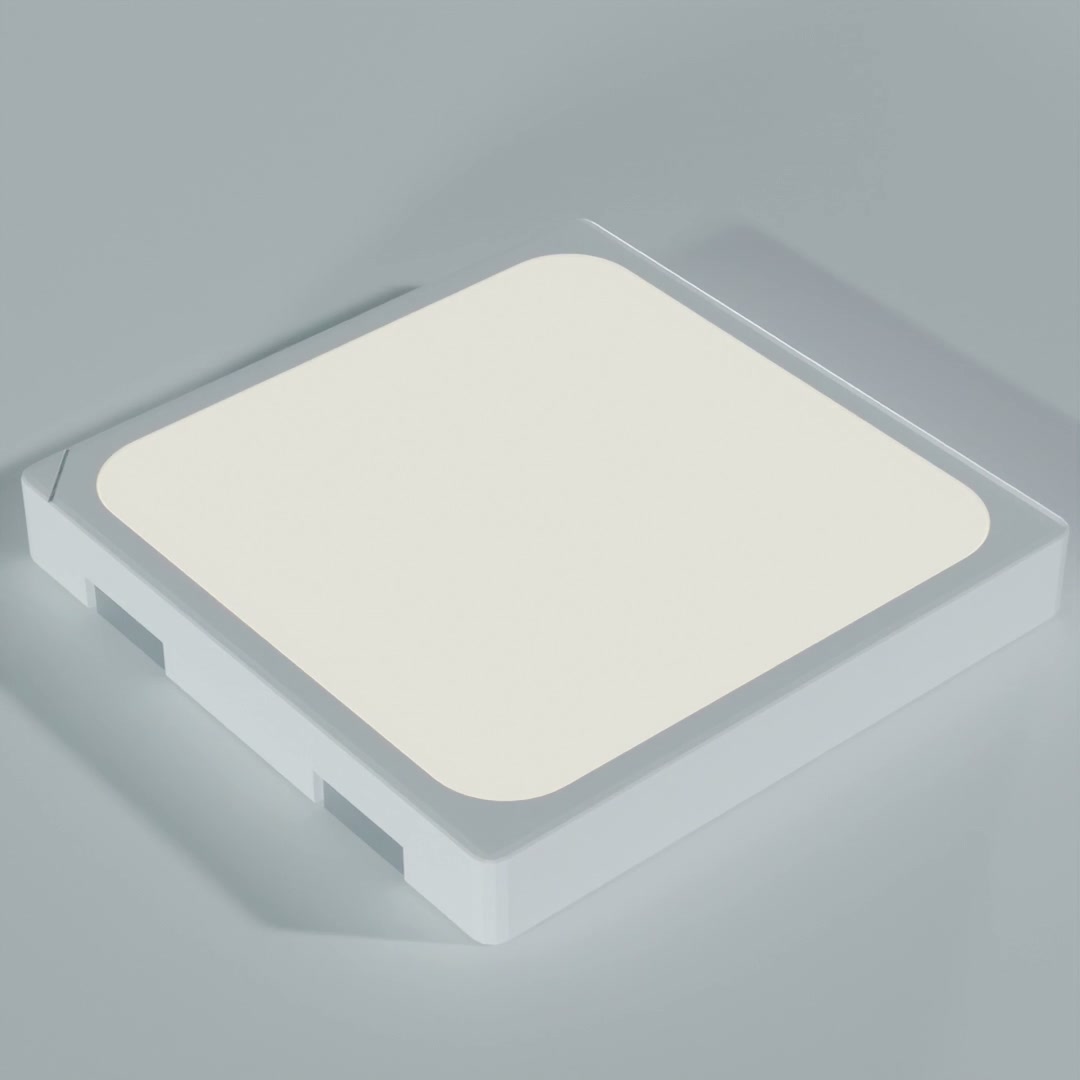
The 5050 LED is the standard package for high-power lighting. I compare a top-bin 5050 with 7070 and 10×10 packages at the same power, look at what separates one 5050 from another, and explain why chip layout matters once you add secondary optics.
Power, luminous flux and efficacy (lumens per watt, lm/W) are calculated with the LedParser calculator from datasheet curves at 25 °C. No prices are listed: cost per lumen is shown only in relative terms.
1In short: 5050 Q9 vs 7070 vs 10×10, efficacy and cost per lumen
The LEDs below come from one of the leading Chinese LED makers: reliable parts with efficacy at the top of the market. I use them here simply as an example to illustrate what this post covers. The baseline is a top-bin 6 V, 10-chip 5050, called 5050 Q9 below. All LEDs use gold bonding wire except the 7070, which is compared in its silver-alloy-wire version. I compare them at about 4.5 W per LED.
Across the top LED makers, efficacy is very close and reliability is high. Prices are where they differ: Chinese makers are cheaper, while LEDs from ams OSRAM, Cree LED, Nichia and Seoul Semiconductor cost more.
Key takeaways from the comparison:
- Best balance: 5050 Q9, 207.3 lm/W at 750 mA (about 4.5 W), with the lowest cost per lumen of the three. 7070 is within 1% of it.
- Highest efficacy: 10×10 and 7070: at about 4.5 W they reach 219.2 and 218.5 lm/W, 5–6% above 5050 Q9. 7070 costs about the same per lumen as 5050 Q9, while 10×10 costs about 4.6× as much.
- At low current, the gap disappears: at about 2 W, 5050 Q9 reaches 235.4 lm/W versus 232.7 lm/W for 7070.
- Driven harder, 7070 pulls ahead: at 950 mA it gives 211.7 lm/W at about 19% lower cost per lumen than 5050 Q9 at 750 mA.
All three LEDs at about 4.5 W. Cost per lumen is relative to 5050 Q9 = 1.00: a 10×10 lumen costs 4.59× as much.
| LED | Chips | Current (mA) | W | lm | lm/W | Cost per lm (×) |
|---|---|---|---|---|---|---|
| 5050 Q9, 6 V | 10 | 750 | 4.58 | 949 | 207.3 | 1.00 |
| 7070, 6 V | 20 | 750 | 4.34 | 949 | 218.5 | 1.01 |
| 10×10, 36 V | 48 | 134 | 4.49 | 984 | 219.2 | 4.59 |
Larger packages can take more power. Below, 5050 Q9 stays at 750 mA, 7070 runs at 950 mA, and 10×10 runs at 350 mA, about 12.6 W:
| LED | Chips | Current (mA) | W | lm | lm/W | Cost per lm (×) |
|---|---|---|---|---|---|---|
| 5050 Q9, 6 V | 10 | 750 | 4.58 | 949 | 207.3 | 1.00 |
| 7070, 6 V | 20 | 950 | 5.59 | 1183 | 211.7 | 0.81 |
| 10×10, 36 V | 48 | 350 | 12.59 | 2348 | 186.4 | 1.92 |
The same three LEDs across their power range, 10×10 up to 350 mA: efficacy on the left, cost per lumen on the right, relative to 5050 Q9 at 750 mA = 1.00.
At higher power, 7070 beats 5050 Q9 on both efficacy and cost per lumen. 10×10 still costs nearly twice as much per lumen. What keeps 5050 the default is optics: 7070 and 10×10 don't fit lenses made for 5050, the package most luminaires are built around.
2Why the 5050 LED is the standard high-power package
SMD 5050 is the package most high-power luminaires are built around. Because a 5050 handles high power, it works well wherever you need secondary optics. You get more power from the same lens, whether it's a single lens per LED or a multi-LED lens over the whole board. That often works out cheaper, making 5050 the most practical choice for high-wattage luminaires today.
It usually gives higher efficacy at a lower cost per lumen than the alternatives. A high-power 5050 is a multi-chip LED: several chips share the package, so each runs at low current, where chip efficacy is highest.
Every major LED maker, in China and worldwide, carries 5050 in its lineup. By volume, it is the leading high-power LED package in the world.
Typical uses:
- Industrial high-bay luminaires
- Street lights
- Sports lighting and floodlights
Multi-LED optics for 5050 cover roughly 12 to 200 LEDs each, from a street light lens to a floodlight lens array for sports lighting with many aiming points. These optics often use a 20–30° beam angle, which suits a 5050 package well.
Narrow beams are the limit. Below about 20°, a 5050 is hard to collimate: its many chips form a large light-emitting surface. For a narrow-beam LED luminaire, or when mounting height calls for it, designers still use a 3535 LED.
3Not all 5050 LEDs are the same
The same 5050 package comes in different voltages: the gold-wire white 5050 LEDs compared here run at 6 V, 9 V and 24 V. Two factors set them apart:
- The number of chips inside and how they are connected.
- The flux bin of the chips. Chip count alone doesn't determine efficacy: high efficacy also needs chips from a top flux bin.
The table compares the highest-efficacy standard 5000 K, CRI 70 gold-wire bin for each voltage, plus two more chip counts at 6 V. Current is set so every LED runs at about 4.5 W. Rows are ordered from the lowest cost per lumen to the highest.
| LED | Chips | Current (mA) | W | lm | lm/W | Cost per lm (×) |
|---|---|---|---|---|---|---|
| 5050, 6 V | 8 | 750 | 4.67 | 831 | 177.8 | 0.89 |
| 5050, 6 V | 12 | 750 | 4.58 | 900 | 196.3 | 0.90 |
| 5050, 9 V | 12 | 500 | 4.50 | 800 | 177.7 | 0.91 |
| 5050, 24 V | 8 | 175 | 4.47 | 796 | 178.1 | 0.98 |
| 5050 Q9, 6 V | 10 | 750 | 4.58 | 949 | 207.3 | 1.00 |
Cost per lumen differs little across the table. Q9's cost per lumen is about 12% higher than in the lowest-cost row, while its efficacy is about 17% higher: 207.3 vs. 177.8 lm/W. The 10-chip Q9 beats the 12-chip 6 V version: here 5050 LED chip bin matters more than chip count.
5050 Q9 lumens and efficacy from 200 to 950 mA
The 6 V 5050 Q9 is rated up to 1 A. At 750 mA, this 5050 Q9 LED outputs 949 lumens, rising to 1,181 lumens at 950 mA, about 6 W. The chart stops at 950 mA, the same as for 7070 below, where the datasheet voltage graph ends. The chart shows how efficacy drops as current rises; the table shows cost per lumen dropping with it: the more light you drive from one LED, the lower the cost per lumen.
| Current (mA) | W | lm | lm/W | Cost per lm (×) |
|---|---|---|---|---|
| 200 | 1.08 | 272 | 250.9 | 3.49 |
| 350 | 1.97 | 464 | 235.4 | 2.05 |
| 500 | 2.91 | 647 | 222.5 | 1.47 |
| 750 | 4.58 | 949 | 207.3 | 1.00 |
| 950 | 6.02 | 1181 | 196.3 | 0.80 |
45050 LED chip layout and secondary optics
How the chips are arranged inside the package strongly affects how the LED performs with a lens. Chips aren't always lined up in neat grids: makers vary their layout and orientation to fit more of them in. Two 5050 LEDs from the same maker with different chip layouts will give different optical efficiency and a different light distribution.
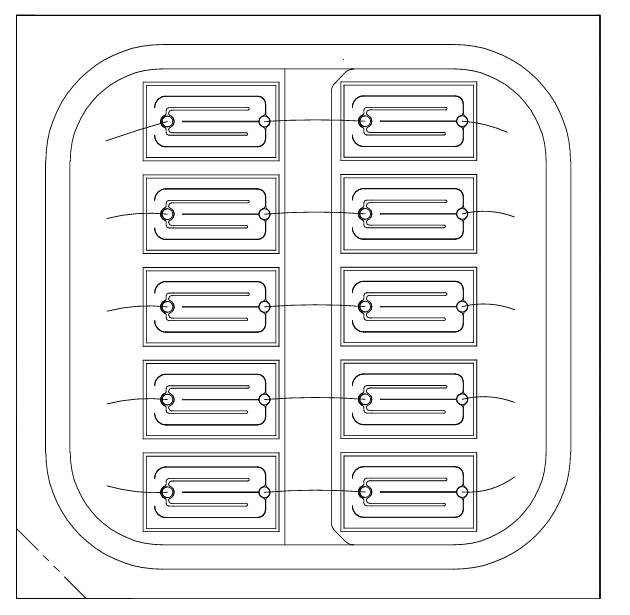
5050, 10 chips in two columns
Ten small chips in two even columns of five.
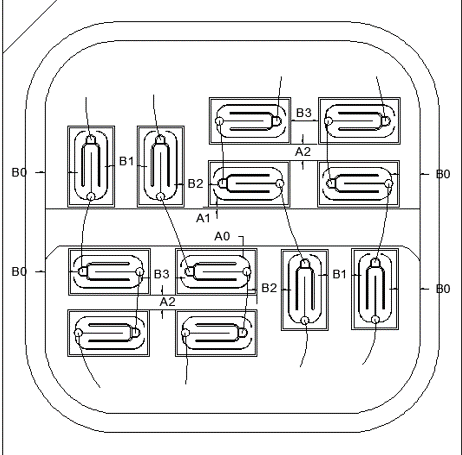
5050, 12 chips in a pinwheel
Twelve chips in a pinwheel layout: four oriented vertically in two opposite corners, eight oriented horizontally in the other two.
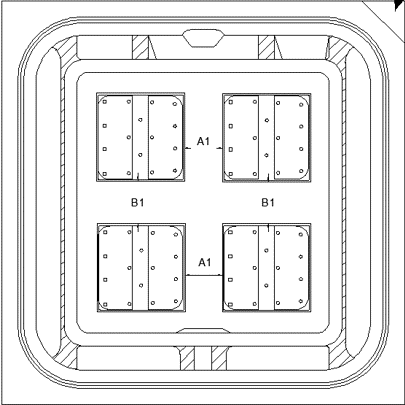
5050, 4 large flip chips
Four large flip chips in a 2×2 grid, with no bonding wires.
So validate the LED and the lens as a pair:
- Simulation first. Request ray files from the LED maker and send them to the optics supplier to simulate the light distribution.
- Then lab measurement. Simulation gives an estimate; accurate figures come only from photometric testing, so almost every project needs it. Build a prototype, measure it in-house or at a third-party photometric lab, and base your luminaire specs on those results.
5Larger packages and LED efficacy: 7070 and 10×10
A larger package leaves room for more chips. When more chips share the same total current, each chip carries less of it. Because chip efficacy drops as current rises, overall LED efficacy improves. 5050 Q9 has 10 chips, 7070 has 20, and 10×10 has 48.
At low current, the extra chips stop paying off: per-chip current is already low in all three packages. At about 2 W, 5050 Q9 reaches 235.4 lm/W (350 mA), 10×10 234.0 lm/W (60 mA) and 7070 232.7 lm/W (350 mA).
7070 LED: 20 chips
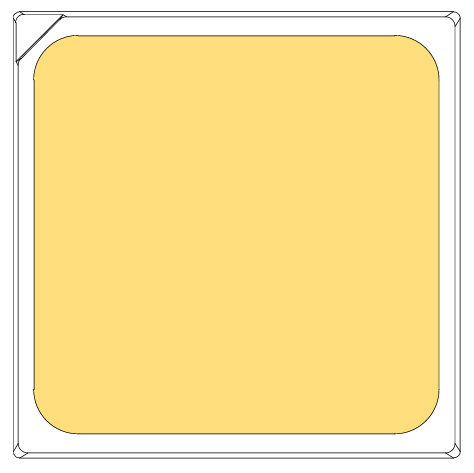
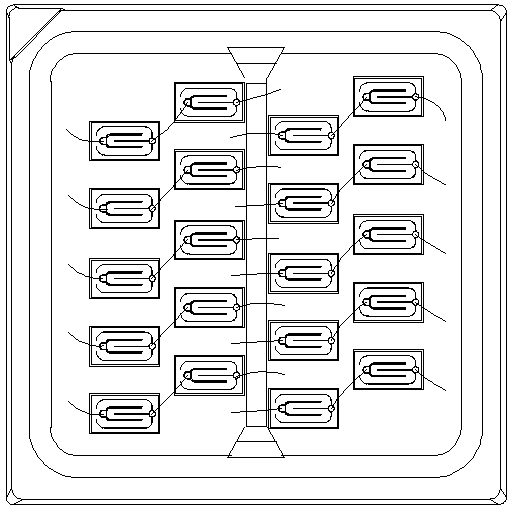
7070, 20 chips
6 V, 20 chips in four columns of five. Silver-alloy bonding wire.
7070 efficacy from 200 to 950 mA:
| Current (mA) | W | lm | lm/W | Cost per lm (×) |
|---|---|---|---|---|
| 200 | 1.10 | 263 | 239.5 | 3.63 |
| 350 | 1.96 | 455 | 232.7 | 2.10 |
| 500 | 2.84 | 645 | 227.5 | 1.48 |
| 750 | 4.34 | 949 | 218.5 | 1.01 |
| 950 | 5.59 | 1183 | 211.7 | 0.81 |
In 5050 Q9, 750 mA splits across 5 parallel strings; in 7070, across 10, so each 7070 chip runs at half the current. At about 4.5 W, 7070 reaches 218.5 lm/W, 5% more than 5050 Q9, at about the same cost per lumen. If efficacy matters more than package size, 7070 is the next step up from 5050. Keep in mind that neither 7070 nor 10×10 fits lenses made for 5050: a larger package means different optics.
10×10 LED: 48 chips, still overpriced
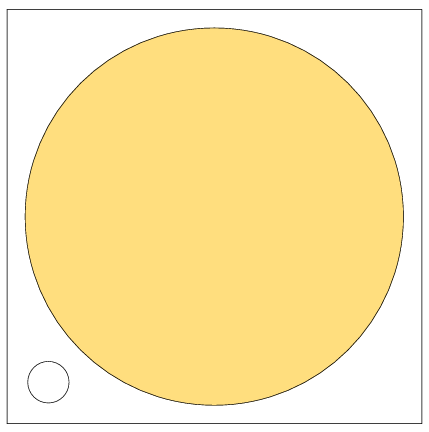
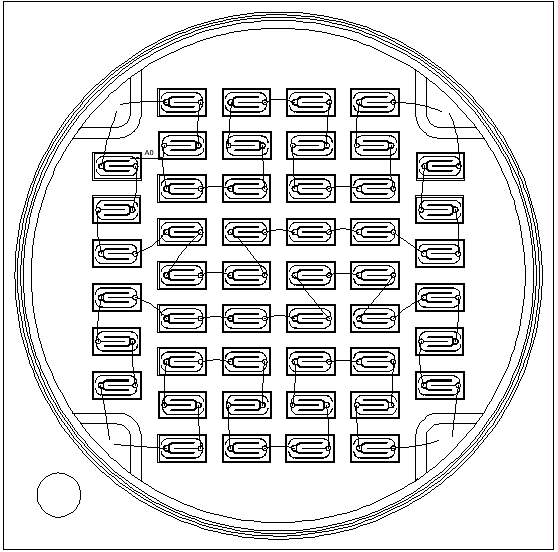
10×10, 48 chips
36 V, 48 chips in a circular light-emitting surface, rated up to 600 mA (about 23 W).
At about 4.5 W, 10×10 reaches 219.2 lm/W, on par with 7070, but its cost per lumen is about 4.6× that of 5050 Q9. At current prices, it's hard to justify.
It is rated up to 600 mA, about 23 W per LED, but at that power heat is hard to remove from such a small package. So I stop at 350 mA, about 12.6 W. One way to bring its cost per lumen down is to drive it harder, but efficacy drops as current rises. The chart shows efficacy; the table shows cost per lumen.
| Current (mA) | W | lm | lm/W | Cost per lm (×) |
|---|---|---|---|---|
| 60 | 1.94 | 454 | 234.0 | 9.94 |
| 134 | 4.49 | 984 | 219.2 | 4.59 |
| 200 | 6.86 | 1439 | 209.6 | 3.14 |
| 300 | 10.61 | 2035 | 191.7 | 2.22 |
| 350 | 12.59 | 2348 | 186.4 | 1.92 |
At 350 mA, 10×10 drops to 186.4 lm/W and still costs 1.92× as much per lumen as 5050 Q9 at 750 mA (207.3 lm/W).
6Conclusions
- 5050 Q9 is the best balance of efficacy and cost per lumen for most high-power luminaires with secondary optics.
- More chips give higher efficacy at high current: 7070 and 10×10 are 5–6% ahead at 4.5 W. At about 2 W, the gain is gone. Neither fits lenses made for 5050.
- Bin matters as much as chip count: a 10-chip Q9 beats a 12-chip 5050.
- 10×10 is still hard to justify on cost: even at 350 mA, about 12.6 W, its cost per lumen is nearly twice that of 5050 Q9 at 750 mA, with lower efficacy.
- Chip layout changes how the LED performs with a lens: validate the LED and lens as a pair, first by simulation, then by lab measurement.
- For beams narrower than about 20°, choose a 3535 LED instead of 5050.
7Check other operating points
All numbers in this post come from the LedParser calculator: pick an LED, set the current, and it computes voltage, power, luminous flux and lm/W from the datasheet curves. You can filter LEDs by specs in LED search.